


 Published: 10:50, November 18, 2026
Wheat continued to rise in price in most regions
Wheat prices with protein 12.5% rose over the week in the Center, the Volga region and Siberia by 200–300 rubles per ton. In the South, grain became cheaper by 200 rubles, according to a monitoring report by farmer and expert Nikita Tokmakov on November 18. All prices are quoted at the farm gate including VAT.

In Central Russia, the main wheat price range was 8.9–10.8 thousand rubles per ton, with individual offers reaching 11.6 thousand rubles. Over the week, the increase amounted to 200 rubles. In the Volga region and Siberia, wheat rose by 300 rubles to 8.5–10.1 thousand and 11.1–12.9 thousand rubles, respectively.
In the South, the main range fell to 7.5–9.2 thousand rubles per ton. Individual offers still reach 11.6 thousand rubles.
Thus, the weekly price increase held in three of the four main regions.
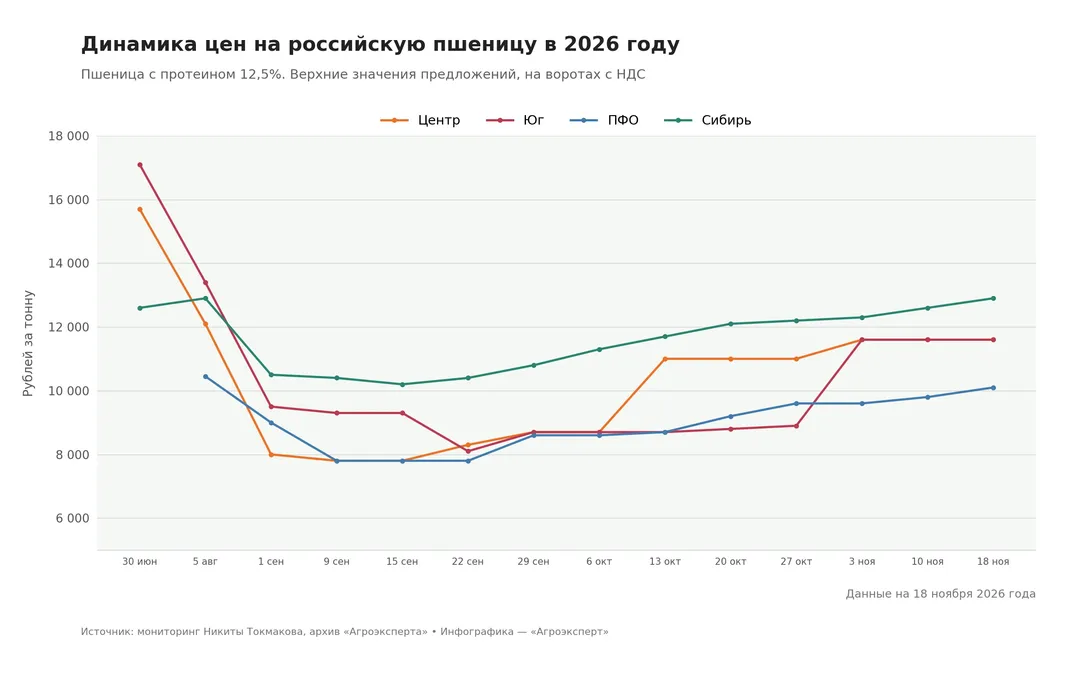
According to Nikita Tokmakov, the grain market is being supported by purchases from flour mills and feed mills. At the same time, in the Center market prices are already close to intervention levels, which, given the terms of sale to the state fund, reduces the attractiveness of participating in the auctions. In the South and the Volga region, the situation is different, but purchases are also proceeding slowly, the expert notes.
Barley is getting more expensive, corn remains under pressure
Over the week, barley rose in the Center by 200 rubles to 7.3–9.4 thousand rubles per ton, and in the Volga region by 300 rubles to 7.2–9 thousand rubles. In the South, prices remained in the 7.1–8.5 thousand ruble range, and in Siberia — 11.9–13.6 thousand rubles.
Corn in the Center became cheaper by 200 rubles to 7.5–11.5 thousand rubles per ton. In the South, the price remained at 7.3–9.9 thousand rubles.
Corn harvesting is not yet complete, and drying facilities are operating under heavy load. Due to equipment breakdowns, intake of wet grain is periodically halted. Many farms continue to sell the crop directly from the field.
The position of sellers of dry corn is somewhat better: the drying cost, according to the monitoring data, reached 200 rubles per ton for each percentage point of moisture reduction.
Soybeans rise in price due to limited supply
Soybeans with protein content of 39–40% in terms of absolutely dry matter became more expensive in the Center by 300 rubles to 34.9–37.8 thousand rubles per ton. In the South, the increase amounted to 200 rubles, with prices reaching 32.5–35 thousand rubles. In the Far East, the range remained unchanged at 31.5–34.5 thousand rubles.
Tokmakov links the rise in the European part of the country to limited supply: farmers are willing to store soybeans while waiting for better selling conditions.
In the Far East, he says, the market is being influenced by opposing factors. China has cut imports amid high raw material stocks at processors and low processing profitability. At the same time, connecting Sodezhestvo’s plant in the Amur region to the power grid creates conditions for higher domestic demand. The first output is expected in November.
Sunflower and rapeseed keep prices steady
Sunflower prices did not change over the week. In the Center, they stood at 23.9–25.7 thousand rubles per ton, in the Volga region — 23.3–25 thousand rubles, in the South — 19.2–23.2 thousand rubles, and in Siberia — 27.1–29.1 thousand rubles.
Rapeseed also held its previous positions: in the Center — 22.9–31.2 thousand rubles per ton, in the South — 26.3–28.8 thousand rubles, in the Volga region — 26.5–29 thousand rubles, and in Siberia — 24.4–26.9 thousand rubles.
 12:48, November 18, 2026
 12:42, November 18, 2026
 11:19, November 18, 2026
 11:08, November 18, 2026
Popular
Нет просмотренных постов.