


 Published: 17:48, November 11, 2026
Wheat prices rise in Russia for the second month
Russian wheat prices continue to recover after falling during the peak harvest period and the halt in exports through the Azov-Black Sea basin. As of November 10, grain with a protein content of 12.5% had risen over the week by 200–300 rubles per ton in all major regions, according to monitoring by farmer and expert Nikita Tokmakov. The price increase, which began in late September, has strengthened and continued for the second month.

In Central Russia, the main wheat price range was 8.7–10.6 thousand rubles per ton, with some offers reaching 11.6 thousand rubles. Over the week, prices rose by 300 rubles. In the South, prices increased by 200 rubles to 7.6–9.3 thousand rubles, with some offers also reaching 11.6 thousand rubles.
In the Volga region, wheat rose by 200 rubles to 8.2–9.8 thousand rubles per ton, and in Siberia by 300 rubles to 10.8–12.6 thousand rubles. All prices in the monitoring are given at farm gate including VAT.
Compared with October 27, the upper end of the main range in the Center increased by 500 rubles per ton, in the South and Siberia by 400 rubles, and in the Volga region by 200 rubles.
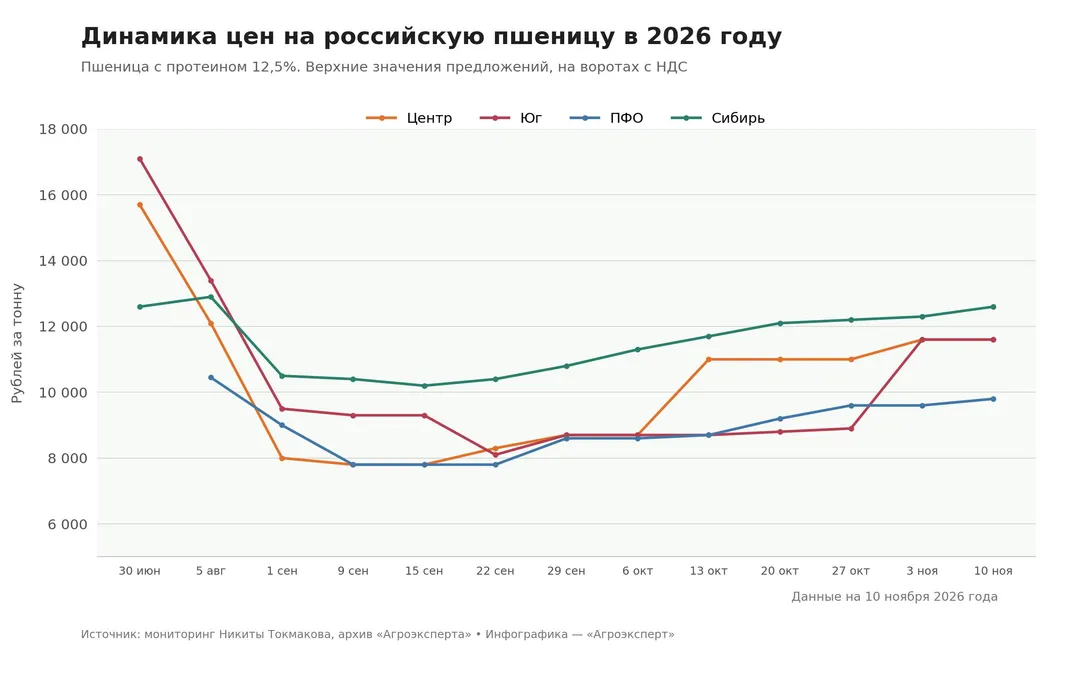
Wheat is being supported by procurement interventions that began on October 29. The benchmark average purchase price for grain of 4 class for the state reserve is about 11.65 thousand rubles per ton including VAT. In the Center, demand for feed grain remains an additional factor.
Against this backdrop, winter sowing is lagging behind last year’s pace. According to the monitoring, by November 7 about 17 million hectares had been sown, or 89% of the plan. The shortfall is about 800 thousand hectares, or 4%.
Barley gets more expensive, corn remains under pressure
Barley, which is not included in intervention purchases, rose over the week in the Center by 100 rubles to 7.1–9.2 thousand rubles per ton, and in the South by 200 rubles to 7.1–8.5 thousand rubles. In the Volga region, prices remained at 6.9–8.7 thousand rubles, and in Siberia at 11.6–13.3 thousand rubles.
Corn in the Center remained in the range of 7.7–11.7 thousand rubles per ton. In the South, it fell by 100 rubles to 7.3–9.9 thousand rubles.
Demand for corn is being supported by shipments through the Caspian Sea. According to the monitoring, exports in October totaled 243.6 thousand tons, remaining roughly at last year’s level. Harvesting is still under way: by November 7, 60% of the area had been threshed, with 10.6 million tons collected versus 8.8 million tons a year earlier. Yield rose from 63 to 69 centners per hectare.
Sunflower and soybeans gain in price
Sunflower seeds rose over the week in the Center by 200 rubles to 23.9–25.7 thousand rubles per ton, in the Volga region by 300 rubles to 23.3–25 thousand rubles, and in the South by 200 rubles to 19.2–23.2 thousand rubles. In Siberia, prices fell by 400 rubles to 27.1–29.1 thousand rubles.
Nikita Tokmakov links the price strengthening in the European part of the country to the actual completion of the harvest and a reduction in urgent sales. Farms with storage capacity are putting the crop into storage in anticipation of higher prices. As of November 7, sunflower had been harvested from 94% of the area, with the crop reaching 19.7 million tons versus 15.5 million tons a year earlier.
Soybeans with a protein content of 39–40% on a dry-matter basis rose in the Center and the South by 200 rubles to 34.6–37.6 thousand and 32.3–34.8 thousand rubles per ton, respectively. In the Far East, the increase was 500 rubles, with prices reaching 31.5–34.5 thousand rubles.
Soybeans are being supported by a smaller harvest than a year earlier. As of November 7, 94% of the area had been threshed, yielding 7.8 million tons versus 8.5 million tons on the same date last year.
Rapeseed gets cheaper in most regions
Rapeseed prices in the Center fell by 200 rubles to 22.9–31.2 thousand rubles per ton, in the Volga region by 300 rubles to 26.5–29 thousand rubles, and in Siberia by 100 rubles to 24.4–26.9 thousand rubles. In the South, by contrast, the crop became more expensive by 100 rubles to 26.3–28.8 thousand rubles.
Rapeseed harvest as of November 7 totaled 6.8 million tons versus 6 million tons a year earlier. The increase was driven by an expansion in the harvested area from 2.9 million to 3.7 million hectares, while yield fell from 21 to 18 centners per hectare.
At the same time, farmers are expanding winter rapeseed plantings for the 2027 crop year: the area has exceeded 1 million hectares, up by 36%. The most notable increase was recorded in the Volga region — by 126%, in the South — by 58%, and in the Center — by 17%.
 10:47, November 12, 2026
 10:14, November 12, 2026
 09:38, November 12, 2026
 09:34, November 12, 2026
Popular
Нет просмотренных постов.